











Union Health Minister Highlights PGI Chandigarh’s Legacy, Prestigious Reputation, and Contributions to Pioneering Clinical Research, Surgeries and a Robust Research Ecosystem
PGI Chandigarh is one of the largest public healthcare ecosystems in North India and a centre of world-class medical care, high-quality medical education, and research: Shri Nadda
“Under the visionary leadership of Prime Minister Shri Narendra Modi, India has taken a monumental leap across sectors including healthcare”
Shri Nadda Highlights Transformational Expansion of Medical Infrastructure since 2014: AIIMS Rise to 23, Medical Colleges to 818, and Total Medical Seats Surge to Over 2 Lakh
682 Graduates, Including 61 PhDs and 114 DMs, Receive Degrees and 95 Medals at the Convocation
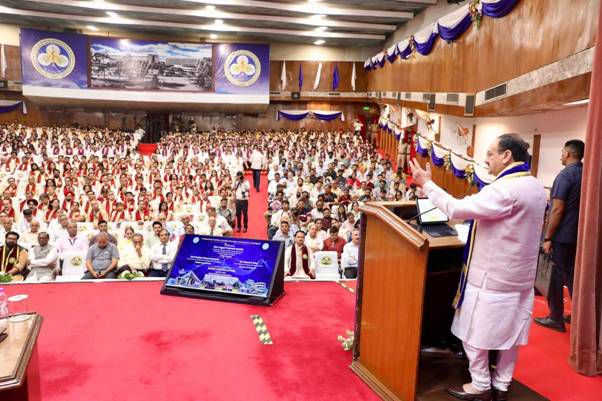
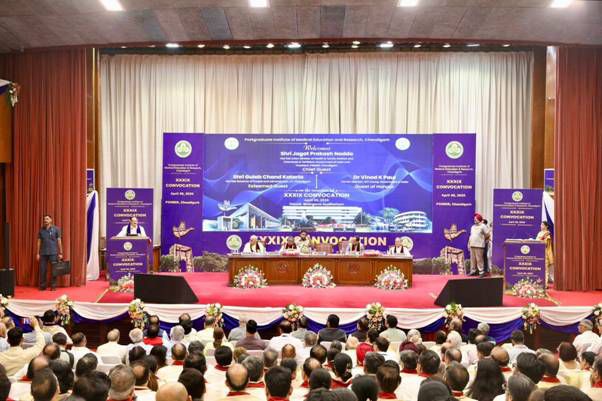
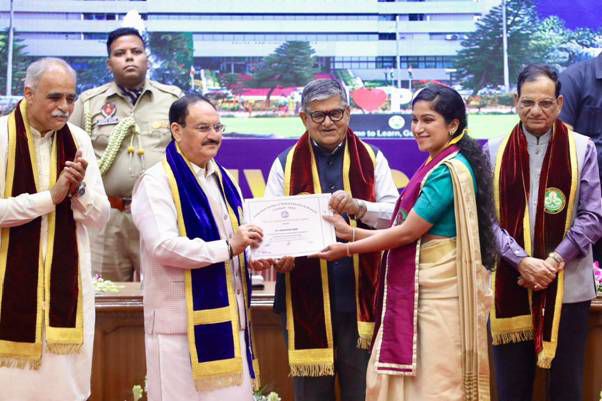
Chandigarh, 30 April 2026: Union Minister for Health and Family Welfare, Shri Jagat Prakash Nadda, addressed the 39th Convocation Ceremony of Postgraduate Institute of Medical Education and Research (PGIMER), Chandigarh, today. Shri Gulab Chand Kataria, Governor of Punjab and Administrator, UT, Chandigarh and Dr. Vinod K. Paul, Former Member, NITI Aayog, Government of India, were also present on the occasion.
Addressing the gathering, Shri Nadda congratulated the graduating students for reaching “an important milestone,” marking the culmination of their hard work, discipline, and determination, as well as the efforts of their teachers, faculty members, and their parents and commended PGIMER for its contribution towards advancing medical science education, and patient care in India.
Shri Nadda highlighted that “PGI Chandigarh is one of the largest public healthcare ecosystems in North India and a centre of world-class medical care, high-quality medical education, and research.” He noted that “over the decades, the dedicated efforts of generations of doctors, scientists, and healthcare professionals have established PGI as a reputed brand name. He remarked that graduates from PGI carry the prestige of the institution with them, and congratulated all students on passing out from this prestigious institute.”
Shri Nadda acknowledged the institute’s contributions to path-breaking clinical research and pioneering surgeries. He noted that “more than 850 extramural projects and over 100 intramural projects are currently being conducted at PGI, reflecting its status not only as a Postgraduate Institute of Medical Education and Research but also as a centre of excellence in education and research.” He also appreciated the institute’s expertise in simultaneous pancreas-kidney transplants, renal transplants, and liver transplants.
Shri Nadda stated that “it is a matter of pride for students to graduate from such a prestigious institution” and expressed his own pride in being part of the congregation as the President of PGIMER, Chandigarh.
Shri Nadda emphasized that “under the visionary leadership of Prime Minister Shri Narendra Modi, India has taken a monumental leap across sectors, including healthcare.” He underscored the role of policy decisions in expanding medical education infrastructure and stated that “by the end of the 20th century, India had only one All India Institute of Medical Sciences (AIIMS) and one Postgraduate Institute. He noted that former Prime Minister Atal Bihari Vajpayee initiated the establishment of six new AIIMS, and in the last 10 years, 16 more AIIMS have been added, taking the total to 23.”
Shri Nadda further stated that the government aims to strengthen tertiary healthcare across the country. He underlined the government’s efforts in the direction of strengthening medical education and stated that “the number of medical colleges has increased from 387 a decade ago to 818 today. Undergraduate medical seats have risen from 51,000 to over 1,26,000, with a target of adding 75,000 more UG and PG seats in the next five years, of which 28,000 have already been achieved in the last two years. Similarly, postgraduate seats have increased from 31,000 to around 81,000-85,000.”
Addressing the graduating students, Shri Nadda emphasized that their achievements are a result of perseverance, hard work, and commitment. At the same time, he reminded them that “while basic education is a right, higher and professional education is a privilege supported by significant public investment.” He highlighted that “approximately Rs. 30-35 lakh per student per year is spent by the government, and Rs. 1.5 crore per student has been sanctioned over the next five years to expand seats in government medical colleges.”
Speaking about the future of healthcare, Shri Nadda highlighted the growing role of technology, including Artificial Intelligence, stem cell research, gene therapy, precision medicine, and telehealth. He emphasized that “while technological advancements are transforming healthcare, the human touch must not be lost.” He stressed that “compassion has its own strength and must remain central to medical practice.” He encouraged students to fully utilise technology for the benefit of patients and society, while ensuring that empathy and compassion continue to guide their work.
He urged students to view their education as a responsibility to give back to society, expressing confidence that they would contribute meaningfully, while noting that convocations serve as an opportunity to remind graduates of their duties. He also encouraged them to look beyond external validation, emphasising the importance of honest self-assessment, continuous improvement, and striving to achieve higher standards of excellence while becoming better professionals and individuals through their own efforts and commitment.
Concluding his address, Shri Nadda noted that the graduating students are entering a new phase of life, where learning will be increasingly practical and responsibility-driven. He advised them to move forward with this understanding and to uphold the standards and values of the Postgraduate Institute of Medical Education and Research, Chandigarh.
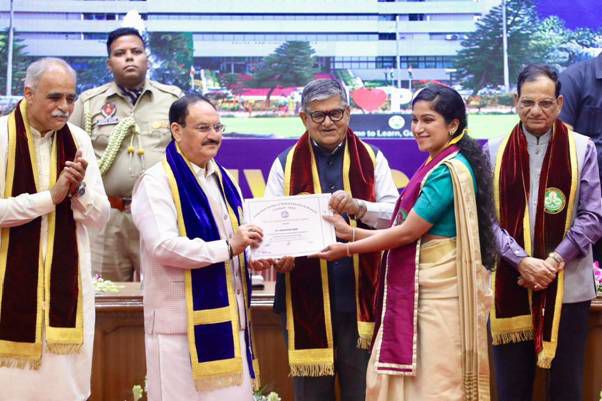
682 candidates, including 61 PhD, 114 DM, 67 MCh, 323 MD, 103 MS, and 14 MDS graduates. In addition, 95 medals (18 Gold, 37 Silver, and 40 Bronze) were conferred, reflecting the Institute’s continued academic excellence and commitment to recognizing the outstanding achievement.
Prof. Vivek Lal, Director, PGIMER and senior officials of the Union Government and Government of Punjab and Chandigarh (UT) were also present.
Background: Established in 1962 and declared an Institution of National Importance in 1967, PGIMER, Chandigarh, is one of India’s premier institutions for tertiary healthcare, medical education, and research. Over the years, the Institute has significantly expanded its patient care services from the original Nehru Hospital to multiple specialized facilities, including the New OPD Block, Advanced Pediatric Centre, New Emergency Block, Advanced Eye Centre, Drug De-addiction Centre, Advanced Cardiac Centre, and Advanced Trauma Centre. Reflecting its continued excellence, PGIMER secured the 2nd rank in the medical category of NIRF 2025, reaffirming its position among the top medical institutions in the country.
PGIMER currently has a bed strength of 2,233 across 47 specialty and super-specialty departments and functions as a high-volume tertiary care centre. Annually, the Institute caters to approximately 27–28 lakh outpatient visits, nearly 1 lakh inpatient admissions, and performs over 95,000 surgeries/procedures. Under the PM-JAY scheme, around 1.81 lakh patients have been treated, highlighting its commitment to accessible and affordable healthcare. The Institute has also demonstrated excellence in transplant services, performing 250 kidney transplants in 2025 and maintaining national leadership in simultaneous pancreas-kidney (SPK) transplantation, with 11 procedures in 2025 and 67 since inception.
The Institute operates under a well-defined governance framework. Academically, PGIMER remains a centre of excellence, offering a wide spectrum of undergraduate, postgraduate, and super-specialty courses across medical, nursing, and allied health sciences. In 2025, the Institute achieved a significant milestone with the graduation of 1,024 candidates, contributing substantially to the country’s skilled healthcare workforce.
PGIMER also has a strong research ecosystem with over 800 ongoing projects supported by national and international agencies such as WHO, NIH, ICMR, DBT, DST, and CSIR. Its research contributions continue to advance clinical practice and public health outcomes. The Institute is equipped with state-of-the-art medical technologies, including robotic surgical systems, advanced MRI and imaging facilities, and high-end diagnostic and surgical equipment, ensuring delivery of cutting-edge healthcare services.
In terms of infrastructure expansion, PGIMER is undertaking several major projects to enhance capacity and outreach. Satellite centres at Sangrur (Punjab) which is already operational and at Una (Himachal Pradesh), and Ferozepur (Punjab) -under construction to expand regional access to specialized healthcare. The Sangrur satellite centre is emerging as a major healthcare hub for the Malwa region, having served over 1.27 lakh outpatients and 824 inpatients, with 35 additional posts created to strengthen its operations.
To improve patient experience and service delivery, PGIMER has implemented innovative practices such as the online indenting system for seamless provision of medicines and consumables. Additionally, under Project SARATHI in collaboration with the National Service Scheme (NSS), around 1,500 volunteers contributed nearly 90,000 service hours, significantly enhancing patient navigation and support services within the Institute.
With its sustained focus on excellence in patient care, education, research, and infrastructure development, PGIMER Chandigarh continues to strengthen its stature as a leading medical institution of national and global repute.