









1.5 to 2 Million Indians suffer from Stroke every Year. – Dr Gaurav Jain
Advance Neuro Intervention services to treat Brain Stroke with Mechanical Throbectomy now at Alchemist Hospital Panchkula. – Dr Amandeep Singh
One Person has a stroke in India every 40 Sec and one fourth of the patients are under the age of 50 yrs – Dr Rahul Mahajan
In case of Brain Stroke patient should be taken to a Stroke Ready Hospital – Dr Manish Budhiraja.
90% of Stroke are linked to 10 avoidable risks – Dr Prashant Maskara.
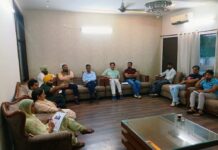
Panchkula 27th Oct 21: On the occasion of World Stroke day to Create awareness on Brain Stroke & Life Style Modification team of Doctors from Alchemist and Ojas Hospital Panchkula, addressed the media person today. Present on the occasion were Dr Gaurav Jain, Consultant Neurology, Dr Amandeep Singh, Sr Consultant Interventional Neuroradiology, Manish Budhiraja Consultant Neuro Surgery from Alchemist Hospital, Panchkula and Dr Rahul Mahajan Consultant Neurology & Dr Prashant Maskara Consultant Neuro Surgery from Alchemist Ojas Hospital.
Addressing the media person Dr Gaurav Jain said “Stroke is emerging as the new epidemic in India with 1.5 to 2.0 million new stroke cases being reported across the country every year. The actual numbers are bound to be higher, as many of these patients never reach health care facilities. Everyday around 3000-4000 stroke happen in India and not more than 2-3% are treated. Worldwide incidence rate of stroke in 60-100 cases per 100,000 population per year, whereas in India it is close to 145-145 cases per 100,000/year. The reason for increased incidence in India is lack of awareness about the disease per se and the methods of prevention. He also shared that Stokes are responsible for more deaths annually than those attributed to AIDS, Tuberculosis and Malaria combined and yet it remains a silent epidemic.
Dr Gaurav Also shared that “India accounts for 60% of Stroke Patients worldwide and the Stroke disease burden in India has increased nearly 100% in last 4 -5 decades”.
.
Speaking on this occasion Dr Rahul Mahajan said that Stroke occurs when the blood supply to the brain is cut short due to a clot (ischemic stroke) or rupture of the blood vessels (hemorrhagic stroke). While 87% of strokes are ischemic by nature, a majority of them can be treated. “The important thing about stroke is that time is of essence. Every minute 1.9 million brain cells die. So patients should be rushed at the earliest to the nearest stroke treatment center. There are mainly two types of strokes. He also shared that almost 50% of strokes occur due to diabetes, high blood pressure and high cholesterol.
Addressing the media person Dr Col Amandeep Singh said till last decade the treatment of ischemic stroke is done by intravenous injection of a drug which can dissolve the clot. Although it is an excellent treatment, but it is effective only if the clot is small and if given within 4 and a half hours of the beginning of stroke. But now with the avaialbity f a new technique called “Mechanical Thrombectomy” which is available now in Alchemist & Ojas Hospital Panchkula, Stroke patients can be treated in selected cases till 24 hours. In this technique the clot is either aspirated or taken out of the brain with the help of a stent retriever without opening the brain. Recently the American Stroke Association has also modified its guidelines and has recommended mechanical thrombectomy treatment for stroke patients. Thus, it is very important to be aware about the hospitals which can offer these treatments. Merely reaching the hospitals is not enough, one needs to reach a Stroke Ready Hospital.
Interacting with Media persons Dr Manish Budhiraja said “developing countries like India are facing a double burden of communicable and non-communicable diseases. Stroke is one of the leading causes of death and disability in India and India has about 1.5 – 2 million new stroke cases every year . Uneven face like drooping of the mouth, one arm hanging down and slurred speech are some of the common symptoms of a stroke and timely treatment can help them prevent the same from occurring. Whenever a Stroke patient is brought to the hospital, he is made to undergo a CT scan which confirms the stroke. Then we inject a needle with drugs to dissolve the clot in brain which has cut the blood supply to the brain. Many a time if a Hematoma is formed, which leads to increases pressure in brain or the Stroke is big enough the we perform Neuro surgery to decompress the brain. Always a Stroke patient should be taken to a Centre, which has Neurology, Neuro Intervention & Neuro Surgery Backup and in house MRI, CT Scan, Blood Bank and good Neuro ICU team.
On this occasion, Dr Prashant Maskara said that Currently, in most of Indian cities including Metros, only 3% of the eligible stroke patients receive thrombolytic drugs to remove clotting as they are brought to hospital on time. The rest are paralysed as they are brought in late to super Specialty hospitals and cannot be administered clot buster drugs. As such on this World Stroke Day, we need to make a conscious effort to sensitize people about these diseases, the right course of treatment and preventive measures that will help them deal with problems. Dr Maskara also shared that both Alchemist & Ojas Hospital are Empanelled with Haryana Govt, Himachal Govt, ECHS, CGHS and all major TPA & corporates and all type of Medical, Interventional & Surgical treatment for Stoke is offered in both the hospitals.
10 things you can do to prevent a Brain stroke
1 Lower blood pressure-Your goal: Maintain a blood pressure of less than 120 (top number) over less than 80 (bottom number).
2 Lose weight- Your goal: Keep your body mass index (BMI) at 25 or less.Try to eat no more than 1,500 to 2,000 calories a day (depending on your activity level and your current body mass index).
3 Exercise more-: Exercise at a moderate intensity at least five days a week.
4 Drink Alcohol in moderation
5 Take a baby aspirin-: Take a baby aspirin every day (after consulting your Doctor)
6 Treat atrial fibrillation- If you have symptoms such as heart palpitations or shortness of breath, see your doctor for an exam.
7 Treat diabetes-Your goal: Keep your blood sugar under control & monitor your blood sugar as directed by your doctor.
8 Quit smoking-Smoking accelerates clot formation in a couple of different ways. It thickens your blood, and it increases the amount of plaque buildup in the arteries. “Along with a healthy diet and regular exercise, smoking cessation is one of the most powerful lifestyle changes that will help you reduce your stroke risk significantly.
9 Be Aware about Stroke.